Introducing floating dry docks
Some sites have the harbour and the steel mill, but not the dock. That's where our floating dry docks come in. Each one is designed for a ship's whole life, up to taking it apart in planned sections, afloat. It needs no quay: it can lie moored or at anchor in a harbour. Where the steel mill is further off, we bring the logistics.
Built for every stage of a ship's life
Built.
Newbuilds and large hull blocks are assembled and launched from the dock.
Kept in service.
Hull modifications, class surveys, decarbonisation retrofits and life extension.
Taken apart.
At the end of its life, a ship is taken apart slice by slice, in planned stages designed to meet international safety and environmental rules. Each section goes onto a barge alongside, and high-grade steel stays whole for reuse.
The same floating dry dock can move between the three as demand changes.
The floating dry dock in figures
Sized for the Panamax fleet, with clear deck space for cutting and assembly. Contaminated water, bilge and ballast included, is captured and processed on the dock. It works independently of the shore: moored or at anchor in a harbour, it loads to and from barges alongside.
- Length overall250.4 m
- Length of the pontoon230.4 m
- Breadth overall68 m
- Width between the walls56 m
- Depth23 m
- Overhang for marine logistics20 m
- Gantry craneFull working length
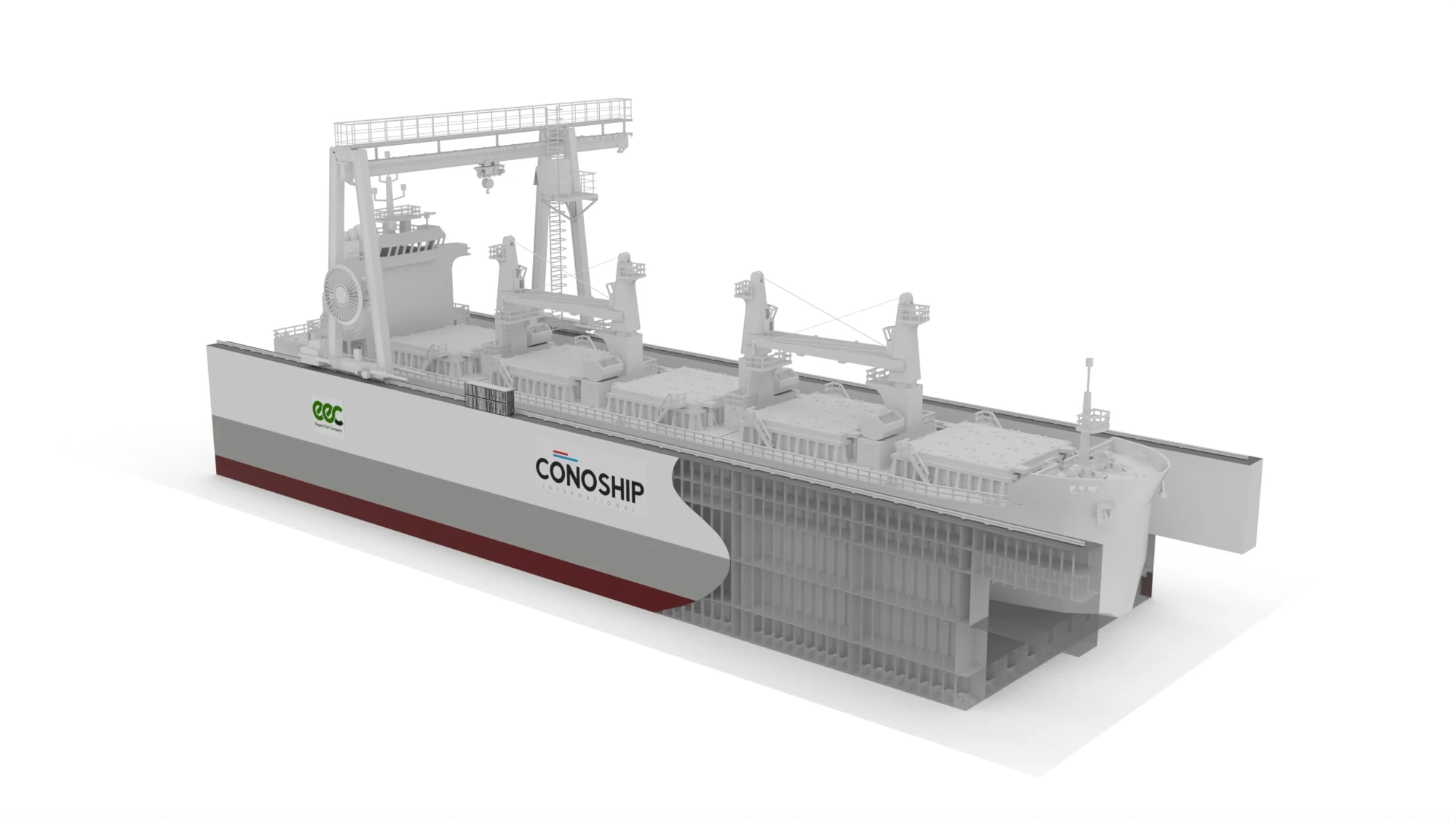
Connected to any steel mill
A steel mill next door is ideal, but it isn't needed. Where the mill is further off, we bring the logistics, as we did with Wan Hai 165, whose steel went to mills in Taiwan, India and the UAE.
- By bargeSections go from the floating dry dock's 20 m overhang straight onto a barge alongside, which carries them on by sea or river.
- By railRail gondolas take cut plate and scrap from the quay to mills inland.
- By shipPlate and scrap go by sea to mills abroad, as on our pilot.
Conoship designed the floating dry dock so that any port and any steelmaker can say “can do”: each site gets the setup its location needs, for a seamless green steel supply chain.
Selling your ships to EEC
You sell your ships outright to a named EEC company, and we stay the owner to the end. Each vessel is then ours: its title, its last voyage, the recovery of its steel and the record of how it all went.
You sell.
One ship or a whole batch, by open tender or direct sale, to EEC Trading BV, our company in the Netherlands. Title passes to EEC.
Taken apart under EEC's oversight.
EEC contracts a certified yard, and the ship is taken apart there under EEC's oversight. The recovered material comes back to EEC.
Our pilot, Wan Hai 165, followed these steps. See the pilot
You pick your involvement
Every sale passes title to EEC. After that, you choose your part in what comes next: from a share of the upside to a place in our own newbuilds.
Profit share
A base price and a share of the upside.
We pay you a base price at the sale, and you share in the profit the ship makes after it.
Fee only
All the profit to you, a modest fee to us.
We take the ship through its last voyage and its disassembly. The profit goes to you, and EEC charges a modest fee.
Your newbuilds
Your old steel in your new ships.
The steel from your old ships goes, as far as it can, into the newbuilds you order.
Our newbuilds
A part in our zero-emission newbuilds.
Take part in EEC's own newbuilds: CABS, Clean Air Bridges and Shuttles. Ask us and we'll tell you more.
What changes for you
The ship's obligations pass at the sale.
After delivery, EEC is the owner, whichever option you choose, and runs everything from the last voyage on.
Our obligations are written down.
What EEC takes on as owner is set out in the sale agreement, so your legal and compliance teams can review it before you sign.
The floating dry dock in the press
What the press wrote about the concept design of our floating dry dock, completed with Conoship International in October 2026. See the design at Conoship(opens in a new tab)
Questions owners ask
- Does selling to EEC end my responsibility for the ship?
Once title passes, EEC is the owner and carries the owner's obligations set out in the sale agreement. Regulators can still look at how any sale was arranged, which is why we keep every step documented and open to review. We encourage your counsel to review the structure before you commit.
- Which regulations apply to my vessel?
It depends on the flag, where the ship is when sold and where it will be taken apart. Rules often involved include the Hong Kong Convention, the EU Ship Recycling Regulation, the UAE Ship Recycling Regulation and the Basel Convention. We map this for each vessel as part of the valuation.
- Who checks EEC?
Both sides go through know-your-customer and beneficial-ownership checks. Our pilot was financially audited by KPMG and overseen by regulatory authorities.
- What if another buyer offers more?
Tell us. We'll match the offer or step aside. We're prepared to run a Swiss Challenge, where a competing offer is tabled and we get the chance to match it.
- Do I commit to anything by requesting a valuation?
No. A valuation is a proposal for you to review.
- Can you take several ships at once?
Yes, that is what EEC's model is built for: one framework agreement, with deliveries phased to suit your schedule. With floating dry docks at more than one site, ships can be taken apart in parallel.
- Can my people observe the work?
Yes. In our pilot, the original owner's safety representative monitored the work.
Ready to go fromshiptono ship?
Tell us about the ships you plan to retire, one or a whole fleet. We'll come back with a structured offer and a plan for the regulations that apply.